

Archiving &
Archive maintenance

Inventorying

Research

Contextualisation

Classification of
restitution assets

Transcription
“A hypothesis is a beginning, not an answer”
I let the object correct me. I do not follow the hypothesis, but the evidence. I do not seek confirmation, but insight.
I question, review and correct. Because my starting point is not certainty, but the question.
Services
My services
My services can be commissioned on a project basis, temporarily, or over a longer period.
Services are billed based on actual time spent at an hourly rate of CHF 80.– to CHF 120.–, depending on the type and complexity of the assignment.
Care, discretion and professional expertise
Responsible handling of historical documents, sensitive information and valuable holdings requires care and discretion.
I work with critical source analysis, transparency and high professional standards—always with respect for the original, its history and the institutional context.
Archiving
Systematic arrangement, cataloguing and long-term safeguarding of documents, holdings and collections according to professional and institutional criteria. Existing structures are taken into account, as are future use and the archive’s long-term traceability.
Billing is based on actual time spent in 15-minute units. Larger inventorying projects are quoted after an initial review of the holdings.
Archive maintenance
Existing archives and collections are reviewed, organised and further developed so that their structures and documentation remain consistent and usable in the long term. This also includes cleaning up organically grown filing systems, supplementing existing cataloguing, and identifying where action is needed.
Billing is based on actual time spent in 15-minute units; individual arrangements are possible for regular or longer-term archive maintenance.
Inventorying
Objects and holdings are systematically recorded, described and documented—from material and formal characteristics to origin, condition and relevant contexts. Recording is based on the existing holdings and can be integrated into existing inventory systems or newly developed ones.
Billing is based on actual time spent in 15-minute units. Larger inventorying projects are quoted after an initial review of the holdings.
Research
Targeted investigation of objects, people, events and contexts using suitable analogue and digital sources. Research results are critically assessed as sources, cross-checked and documented so that findings and remaining uncertainties remain traceable.
Billing is based on actual time spent in 15-minute units. The maximum research effort can be defined before work begins.
Contextualisation
Objects and holdings are systematically recorded, described and documented—from material and formal characteristics to origin, condition and relevant contexts. Recording is based on the existing holdings and can be integrated into existing inventory systems or newly developed ones.
Billing is based on actual time spent in 15-minute units; for more extensive enquiries, based on a cost cap agreed in advance.
Classification of restitution assets
The origin, ownership and historical contexts of restituted or restitution-relevant objects are investigated and documented. The focus is a source-critical reconstruction of provenance that makes established findings visible as well as gaps, contradictions and open questions.
Billing is based on actual time spent in 15-minute units. Due to the difficult-to-predict scope of research, work is preferably carried out with a cost cap agreed in advance.
Transcription
Handwritten or otherwise hard-to-access historical documents are transcribed faithfully into a readable text that can be reused. Illegible passages, uncertainties, abbreviations and peculiarities of the original are clearly marked and, on request, commented on.
Billing is based on actual time spent in 15-minute units. For larger sets of documents, an effort estimate can be prepared after reviewing a representative sample.
How I work
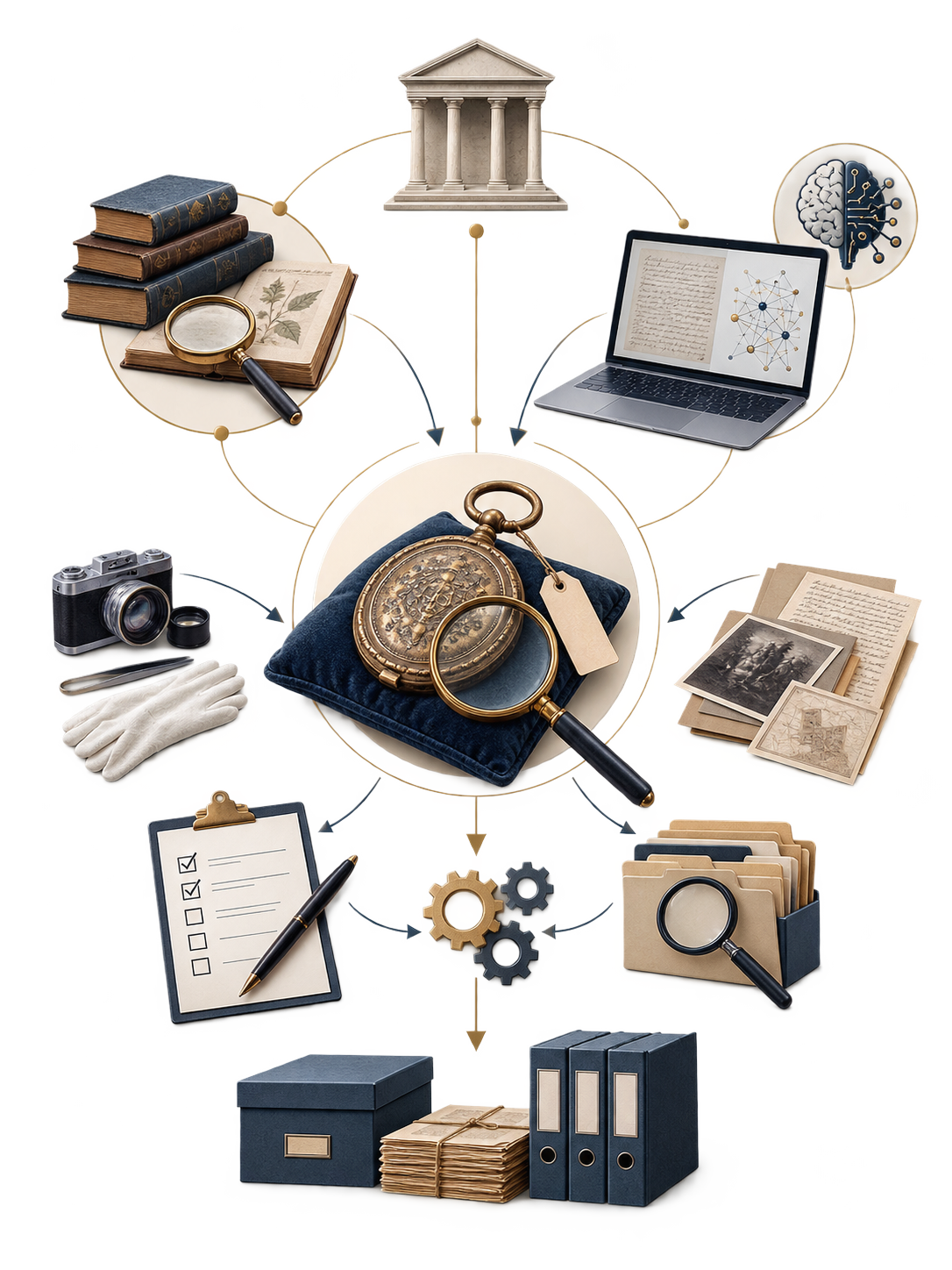
My approach is object-oriented, source-critical and iterative.
As a rule, I start with the specific object and first examine its material, bibliographic and content-related characteristics. On this basis, I assess its significance in the respective institutional and thematic context and determine which information is relevant for sound cataloguing.
For research and analysis, I use traditional sources as well as digital tools and modern technologies, including artificial intelligence. I treat their results as working hypotheses and research aids, which I consistently verify against the object and suitable sources. Deviations, uncertainties and contradictory findings are documented, critically assessed and, where necessary, investigated further.
My goal is precise, transparent and consistent cataloguing. Technological support can broaden research and make it more efficient—the professional assessment complements it, but does not replace it.
I am guided not by the need to confirm an assumption, but by the willingness to let it fail against the reality of the object.
Who I am
I am Corinne Paolillo
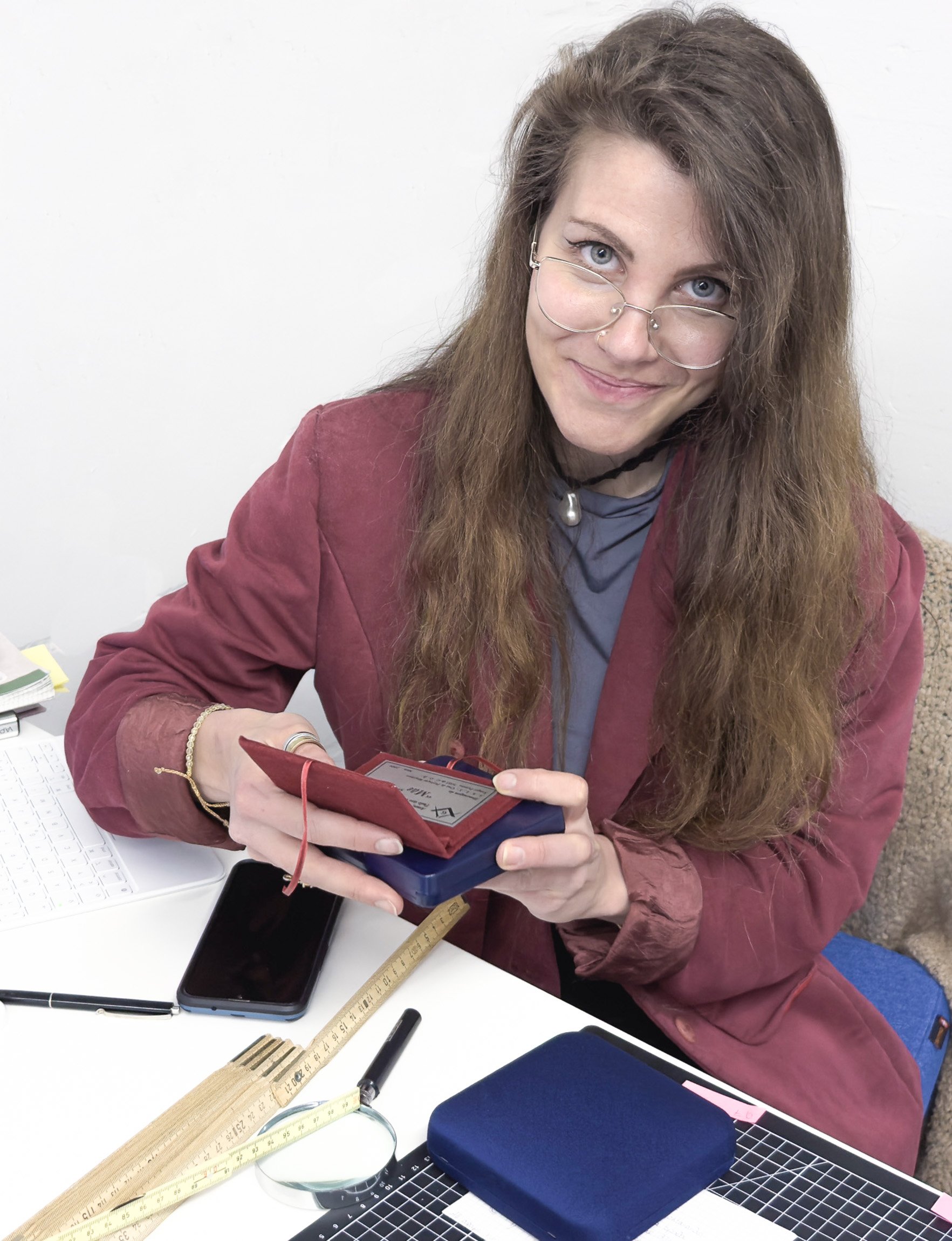
I am a theatre scholar and multimedia producer with a master’s degree from Sapienza University of Rome. My academic training taught me not to view objects and sources in isolation, but to look closely, research connections, and critically review and contextualise information.
Even during my work at Sapienza University, I worked with the cataloguing and management of metadata as well as the systematic recording and preparation of information. In addition, I have practical experience in inventorying a wide range of holdings—from museum objects to books and magazines to comics. This diversity, in particular, has sharpened my awareness that every collection has its own logic and that cataloguing therefore cannot simply follow a rigid scheme.
My work combines academic rigour with a strong understanding of digital tools and technologies. I am interested not only in individual objects, but also in the stories, relationships and contexts behind them. I work analytically and in a structured way, while also maintaining the necessary curiosity to follow unexpected leads.
This combination of academic methodology, practical experience and technical expertise forms the basis of my self-employed work in the areas of archiving, inventorying, research and cataloguing.
Contact
Contact
Do you have a collection, an individual object or a question with which I can support you? I would be pleased to discuss your request with you without obligation and clarify which form of collaboration makes sense.
I look forward to hearing from you.
Corinne Paolillo Archivservices
Wernerstrasse 10
3006 Bern